


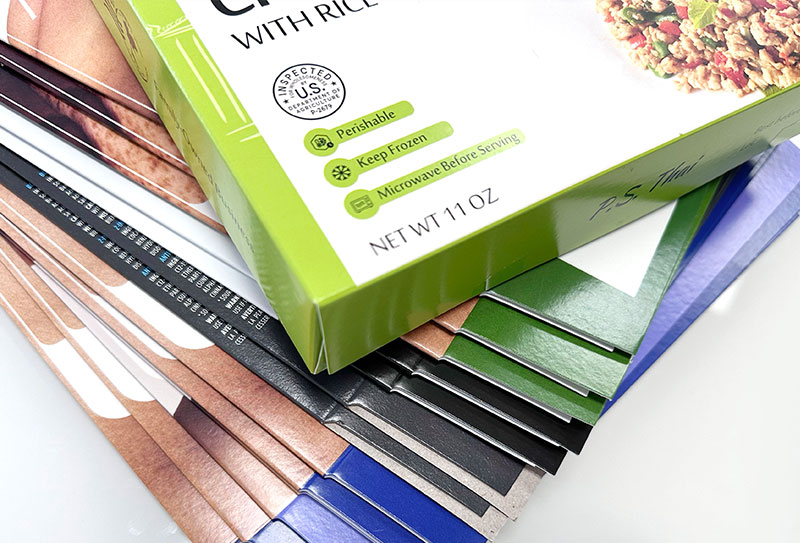

PRACTICAL PACKAGING GUIDE
Sustainable Paperboard Packaging Guide
A practical framework for choosing paperboard, reducing unnecessary material, documenting sourcing and recycled content, evaluating finishes, and making environmental claims that are specific and supportable.
The short answer
Sustainable paperboard packaging is not a single material or logo. It is a verified design and sourcing process that protects the product with the least appropriate material, considers manufacturing and distribution, and accounts for the complete package at end of life. “Paper-based” does not automatically mean recyclable, compostable or low-impact.
A better decision hierarchy
Protect the product first
Damage, leakage, contamination or shortened shelf life can outweigh a packaging reduction. Establish barrier, strength and regulatory needs before selecting the board.
Right-size the structure
Reduce avoidable board area, empty space and redundant inserts while preserving stacking, filling, shipping and retail performance.
Verify fibre sourcing
Request the applicable chain-of-custody claim and confirm the certificate scope, facility and validity. See Beneco’s FSC information.
Specify recycled content accurately
State whether content is pre-consumer or post-consumer and document the exact percentage. Check appearance, odour, strength and product-contact requirements.
Review converting and finishes
Windows, laminates, metallized layers, heavy coatings, adhesives and mixed-material inserts can affect separation and recovery.
Design for the real recovery system
Collection, sorting and end markets vary by location. Evaluate the complete finished pack—not only the base paperboard.
Environmental claims: what evidence should support them?
In Canada, both the literal wording and the overall impression of an environmental claim matter. Use specific, verifiable language and keep the substantiation available.
| Possible claim | Evidence to confirm | Common risk |
|---|---|---|
| FSC-certified / responsibly sourced | Valid chain-of-custody certificate, correct product claim and approved trademark use. | Using a logo or sourcing statement outside the certificate or product scope. |
| Contains recycled content | Exact percentage, source documentation, and whether it is pre- or post-consumer. | Implying the entire package has the same content when only one component does. |
| Recyclable | Assessment of the finished pack, coatings, windows, adhesives, collection, sorting and end markets in the target geography. | Treating “made of paper” as proof that every local program accepts it. |
| Compostable / biodegradable | Applicable testing or certification, disposal environment, timeframe and clear use conditions. | Using broad terms without conditions or evidence. |
| Plastic-free | Defined scope covering windows, barrier coatings, inks, adhesives, liners and closures. | Ignoring small components or polymer-based functional layers. |
| Reduced material / lightweighted | A named baseline, comparable function, measurement method and percentage reduction. | Using “less” without identifying what product or period is being compared. |
Finishes and structural trade-offs
- Barrier coatings: necessary performance may be essential, but the coating chemistry and weight can affect repulpability or acceptance.
- Windows: improve product visibility, yet may add a second material and separation question.
- Foil and metallized effects: deliver shelf impact; specify only where they add measurable value and confirm recovery implications.
- Inserts: paperboard inserts may simplify a structure, while mixed foam or plastic components can complicate claims.
- Ink and coverage: artwork, curing and coverage should be reviewed with the converter for the intended application.
Compare these choices with the custom folding carton cost guide and Beneco’s packaging formats.
Documentation checklist for a packaging brief
- Product protection, barrier, food-contact and shelf-life requirements
- Finished dimensions, pack weight, filling method and distribution conditions
- Board grade, caliper, virgin or recycled fibre requirement and acceptable tolerances
- Requested certification claim and chain-of-custody documentation
- Every coating, laminate, window, adhesive, ink, insert and closure
- Target sales regions and the recovery systems used for any disposal claim
- Claim wording, comparison baseline, test results and approval owner
- Proof and production records retained for future substantiation
Beneco sustainability and certification resources
Beneco publishes information about its sustainability approach, sustainable paperboard options, FSC certification and EcoVadis assessment. Certificate scope and validity should always be checked for the specific facility, material and order.
For food applications, also review the custom food packaging guide. Product-contact suitability, migration, barrier and process-control requirements take priority over a general environmental preference.
Primary guidance used for this page
- Competition Bureau Canada: Greenwashing guidance for businesses
- Competition Bureau Canada: Environmental claims and the Competition Act
- Office of Consumer Affairs: Environmental labels and claims
- Forest Stewardship Council: Chain of Custody standards
Share the product, structure, quantity, finishing and claim requirements for review.